



Welcome to CAPIC
When Prevention Becomes A Privilege
CAPIC’s Executive Director, Richelle Cromwell, is thrilled to share that The American Journal of Public Health has published a paper highlighting CAPIC’s lung cancer screening collaboration with Tufts COHERE.
This collaboration with the Tufts COHERE Program and CAPIC’s SUDS/Mobile Outreach Program increased local health literacy and lung cancer screening rates by using customized educational materials and structured supports to bridge gaps in care in Chelsea. More details about this amazing initiative can be found in the link below. CAPIC is grateful for the continued partnership with the Tufts COHERE Program, and we thank our SUDS/Mobil Outreach Program for their efforts in providing these critical resources to local individuals.

CAPIC Board of Directors Meeting
The Community Action Programs Inter-City, Inc. (CAPIC) Board of Directors will conduct the annual meeting of the corporation on Thrusday, October 29th, 2026. The meeting will be held virtually via Zoom. The meeting will begin at noon and the public is invited to addend.
For questions, please contact CAPIC’s Cary Havey at (617) 884-6130, Extension 1142
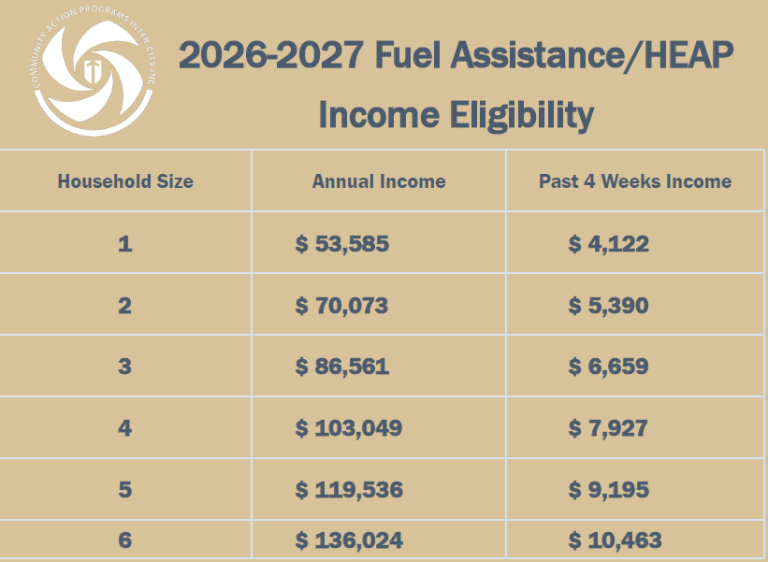
The 2026-2027 heating season is almost upon us!
The online portal for returning applicants opens October 1st 2026, and re-certification paper applications will be mailed to returning applicants by November 1st 2026.
Returning applicants will need their CAPIC application number and pin to submit through the online portal.
Be sure to check out the updated 2026-2027 heating season income guidelines to see if you qualify. Please call 617-884-6130 (press “1” to reach the Fuel Assistance/HEAP Department) with any additional questions about the income guidelines, and/or if you need assistance with your application number and pin.
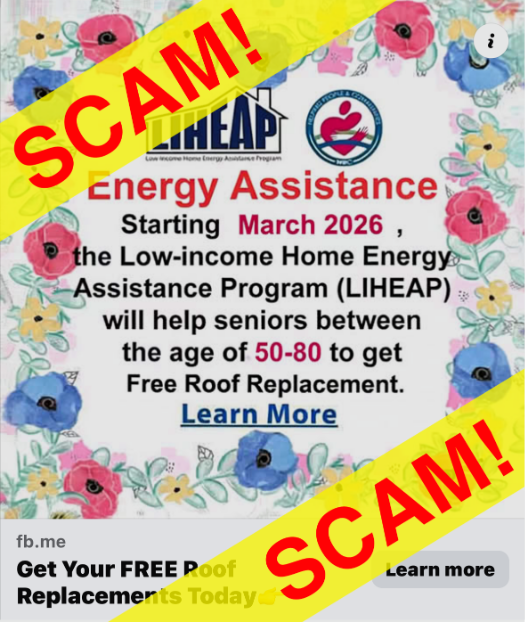
BE ADVISED:
This screenshotted social media post is a scam. While HEAP (formerly known as LIHEAP) does NOT provide free roof replacements and is not exclusively for seniors, HEAP does help eligible households across Massachusetts pay for a portion of their winter heating bills, starting in November and running through April.

CAPIC’s FY25 Agency Impact Report is Here!

The Agency Impact Report highlights services and support provided to individuals, families, and households throughout the communities served by CAPIC during FY’25. We thank our partners, donors, and employees for their continued dedication to helping those in need.
IMPACT STATEMENT FROM CAPIC
April 22, 2025
To our valued clients, partners, and the Chelsea, Revere, and Winthrop communities:
In light of recent news regarding federal workforce reductions and the closure of regional offices impacting Head Start and the Home Energy Assistance Program (HEAP – Fuel Assistance), we want to provide reassurance and clarity.
It’s business as usual at CAPIC!
Our Head Start classrooms remain open, our fuel and energy assistance programs are fully operational, and our commitment to serving our community remains as strong as ever. While the federal landscape may be shifting, CAPIC continues to deliver the essential services our communities rely on each and every day.
We understand that headlines can cause uncertainty, especially for families depending on programs like Head Start and HEAP- Fuel Assistance. Please rest assured: 𝐭𝐡𝐞𝐫𝐞 𝐢𝐬 𝐜𝐮𝐫𝐫𝐞𝐧𝐭𝐥𝐲 𝐧𝐨 𝐝𝐢𝐬𝐫𝐮𝐩𝐭𝐢𝐨𝐧 𝐭𝐨 𝐭𝐡𝐞 𝐬𝐞𝐫𝐯𝐢𝐜𝐞𝐬 𝐲𝐨𝐮 𝐫𝐞𝐜𝐞𝐢𝐯𝐞 𝐭𝐡𝐫𝐨𝐮𝐠𝐡 CAPIC. Our team is in close communication with our state and national partners, and we are actively monitoring these daily developments to ensure that any changes at the federal level are communicated clearly to our community as we weigh the impact on our programs locally.
Founded in 1967 as part of the War on Poverty, CAPIC has navigated change for almost six decades—and we will continue to do so with transparency, resilience, and a deep commitment to the people we serve.
CAPIC is here for you, and we will continue to advocate, adapt, and deliver on our mission: to identify and address the needs, problems, and concerns of those in poverty and to enable the individually poor to achieve and maintain self-sufficiency.
If you have questions or concerns, please contact our office directly.
FY24-26 Community Assessment Report
CAPIC is excited to share our FY24-26 Community Assessment Report. This report provides a detailed overview of our service areas and the needs within the communities that we serve. We gathered input from a broad range of stakeholders, including CAPIC clients, social service providers, local partners, public officials, faith community representatives, school officials, and community members.